
Unless
Addressing social media through the lens of The Lorax
At the far end of town where the Grickle-grass grow and the wind smells slow-and-sour when it blows and no birds ever sing excepting old crows... is the Street of the Lifted Lorax.
And deep in the Grickle-grass, some people say, if you look deep enough you can still see, today, where the Lorax once stood just as long as it could before somebody lifted the Lorax away.
In case it isn't clear, these are the opening lines for the Dr. Seuss book, The Lorax.
At first read, the lesson is obvious. If we do not collectively take responsibility for the stewardship of the environment, then our own world will soon be like the one that the Lorax left behind. [1]
But I believe the lesson in this book goes deeper.
Yes, yes, it is clearly an environmentalist message. But I think too many take environment to mean what it has come to mean.
"We must protect the environment." This message is interpreted as protecting habitats, oceans, forests, animals. etc. In other words... The Earth.
This all certainly falls within the realm of environment, but let's take a look at the dictionary definition.
Environment
the surroundings or conditions in which a person, animal, or plant lives or operates.
For our purposes, we can shorten that to, the surroundings or conditions in which a person lives or operates.
Increasingly, humans appear to be operating online. The infrastructure of the web that connects us has been rapidly expanding over the past 20 years. With the invention of bots, I'd wager that more "people" are on the internet than are in the physical world.
Whether or not that is true does not change the simple lesson of The Lorax... If we do not collectively take responsibility for the stewardship of the environment, then our own world will soon be like the one that the Lorax left behind.
We see this lesson coming true in our physical world, the Earth. But how are things playing out in the digital world?
"Now I'll tell you," he says, with his teeth sounding gray, "how the Lorax got lifted and taken away..."

Discovering the internet in the late 90's felt like the discovery of this rich valley. It was open and expansive with no end in sight, stretching on for miles and miles.
The best part, for me, was the people. I could be completely anonymous, like the Once-ler above, and interact with people from across the globe. As a fairly shy (in real life) individual, this was life-changing. I could share myself with the world without the fear of judgment on my exact person. I would merely be judged on an anonymous profile.
What's more, is I could find my tribe! The people who had similar interests and were interested in sharing, like me.
Little did I know that my preference for anonymity would serve me well. After all, I was not the only one who came along and noticed the trees.
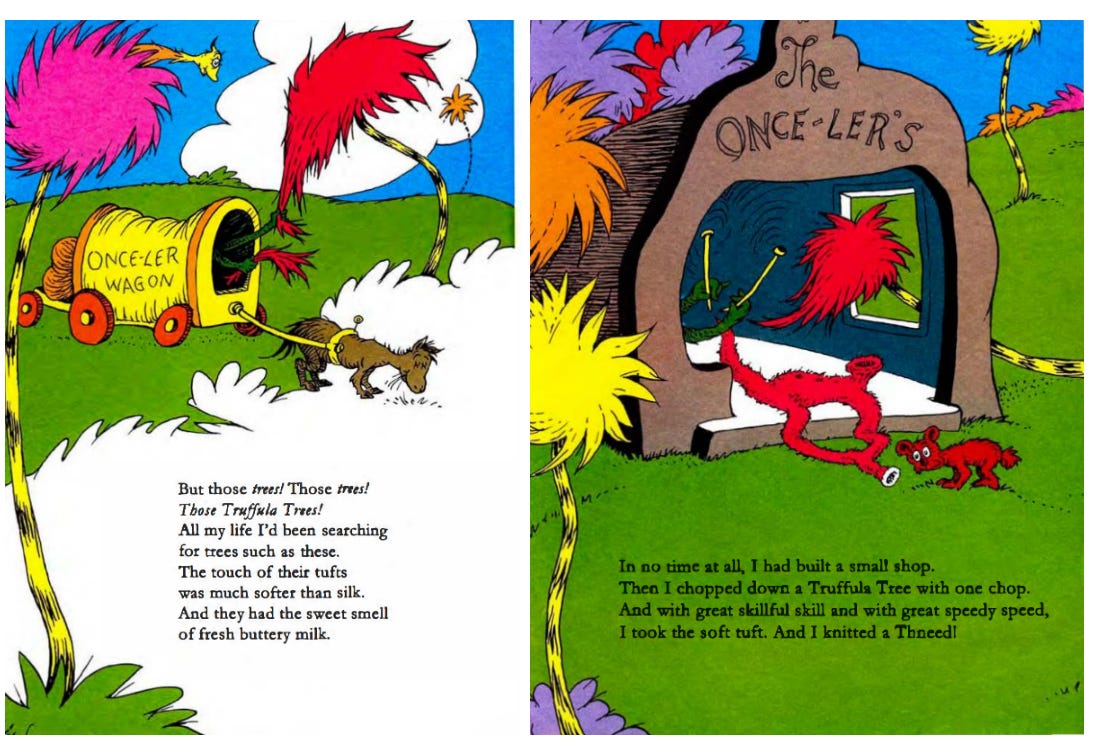
Of all the things in the environment (swans, bears, fish, etc), the Once-ler was most enamored with the trees. He built a little workshop and worked with great speed. Producing a fine-something-that-all-people-need.
In the book, that fine-something is a Thneed. A silly little product, but one that draws attention, none the less. For me, in the early 2000’s, that product was social media. Or put more cynically, that product was people.
An environment built for sharing with people! That's what first drew me to the internet, after all. I wanted to connect and share. I wanted to give my opinions and receive some back. I wanted conversation and mutual discovery.
But what did I find?
I found a fair bit of hostility and a heaping helping of self-centeredness. No bother, for social media is much like a Thneed. It is not just one thing, you see...
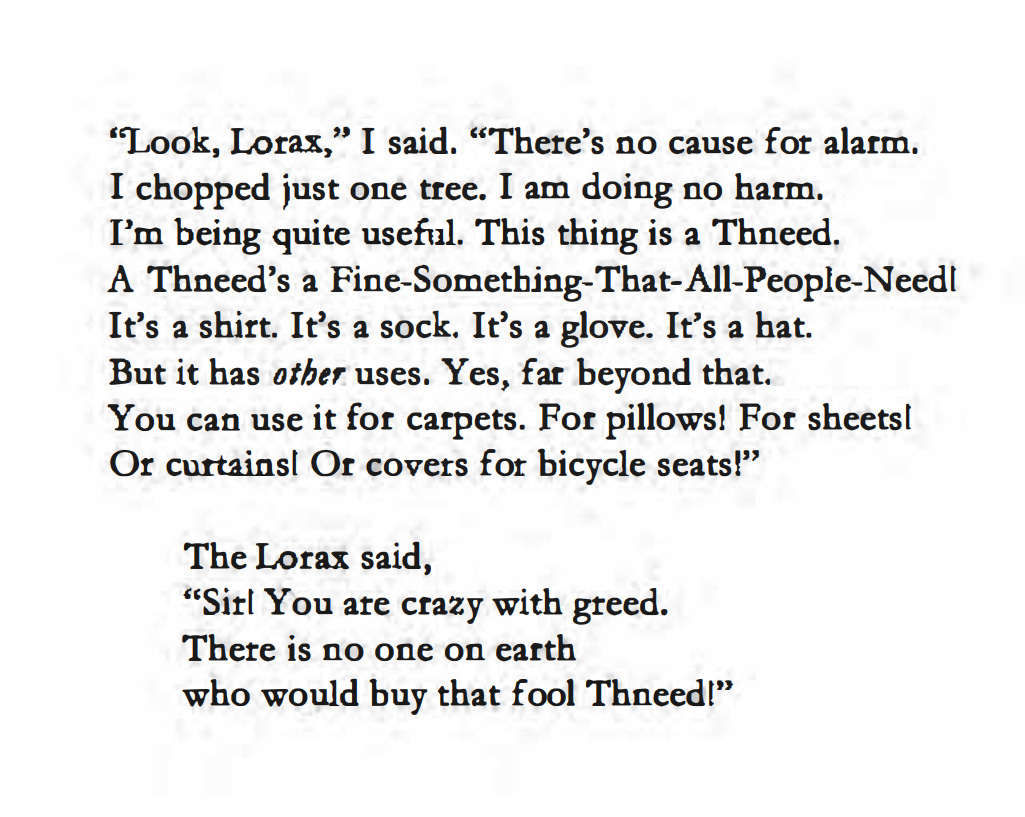
Despite the negative general attitude in a lot of corners of the internet, there were also lovely corners! Places where people were more willing to engage in civil discourse. Where you could be anonymous and yet still form an identity. The internet goes on for miles and miles, after all.
So while some may use it is as a shirt, a sock, a glove or a hat, others may use it for carpet or pillows. There are near-endless ways to use social media.
There is Facebook which houses all of your family and friends. There is Snapchat which is for more intimate and private. Reddit for anonymity and community specification. Twitter for quick engagement, even with celebrities.
But it isn't just the big social media platforms. There are dating apps that cater to specific populations. Forums for all types of professions/hobbies. And even blogs catered to niche interests.
Yes, the internet has it all.
For whatever you search can be found with our Thneed. We'll connect you with all of the people you need.
Yes! We collect all the people, just like Truffula Trees. We collect then connect to your personal feed.
We collect all the people and keep them engaged. We feed them more content that keeps them enraged.
Oh dear, my rhymes seem to be going off the rails. Let's check back in with the Once-ler. Surely I'm just getting carried away.
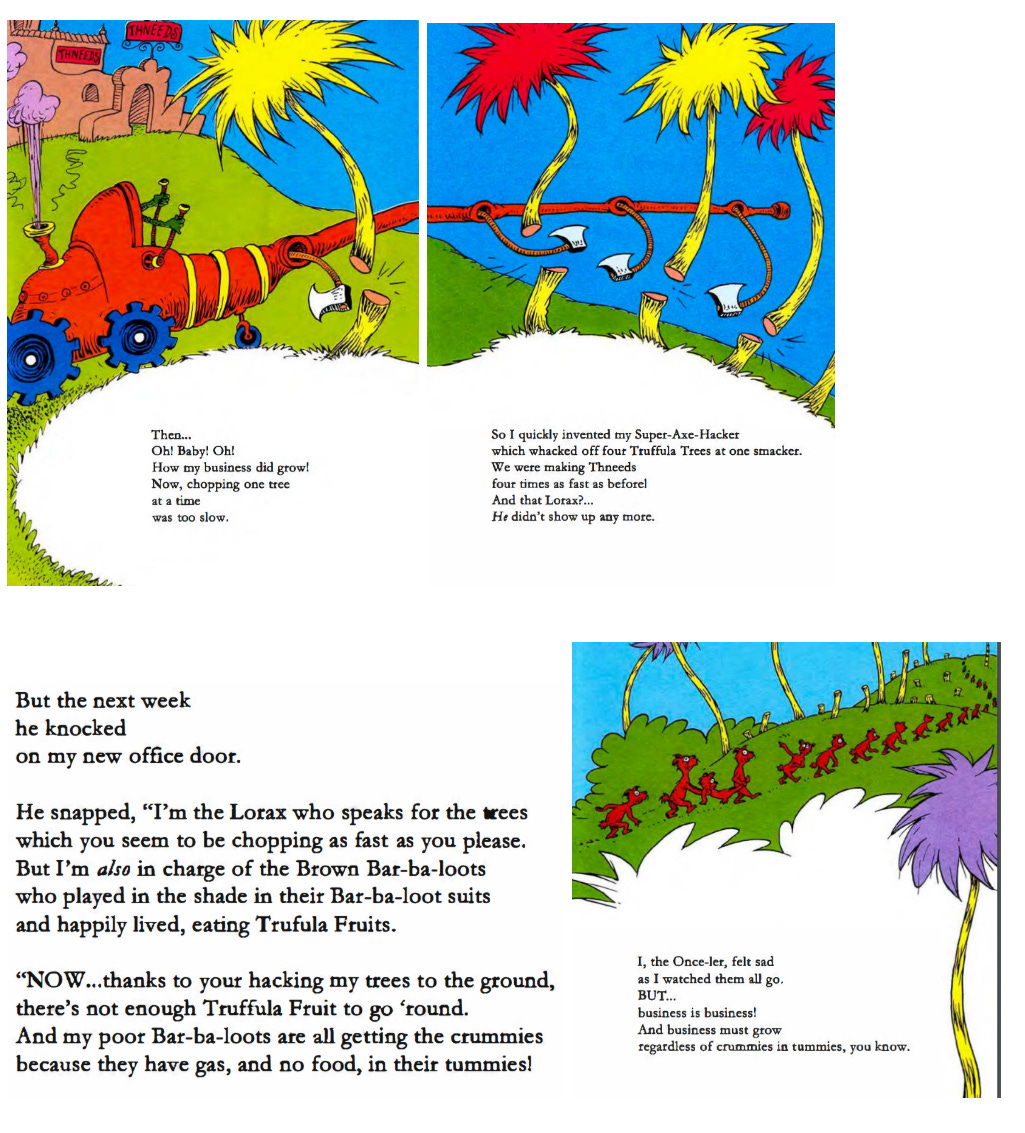
Ugh oh, the poor Bar-ba-loots! They're not getting access to that wonderful fruit! On top of that, the smog spewing out of the Super Axe-Hacker is filling their tummies with gas.
Just like trees are collected and made into Thneeds, we have people connected and placed into Feeds.
And just like the invention of the Super Axe-Hacker, we needed a way to get more people onto these platforms and to keep them there! Doing things one at a time was too slow!
After all, business is business and business must grow.
What method is developed to collect and connect all of these people? The Feed.
The feeds are deliberately designed to be endless.
“Companies have systematically removed stopping cues – those brief moments, like reaching the bottom of a screen, that suggest you might want to move on to something else,” says Adam Alter, psychologist at New York University and author of Irresistible: The Rise of Addictive Technology And The Business Of Getting Us Hooked.[2]
In addition, social media preys on our dopamine system. When we get hits of dopamine, we want more! The problem, as the article above points out, is that our brain “isn’t able to distinguish between useful habits, such as feeding ourselves or paying the rent on time, and those that are destructive, such as smoking or doing drugs.”
Every day more people are coming online. And every day the machine that has been built to feed these people content chugs along. With the priority set on keeping people engaged, the content tends to be that which most confirms our own worldview.
We like feeling validated that we are right. But even more, we like to feel validated that others are WRONG. It is so easy to get sucked into a feed that creates a bubble reality. Even more, it is easy to fall into a negative spiral based on a feed filled with shit!
So what happens when the content we consume is the mental equivalent of junk food?
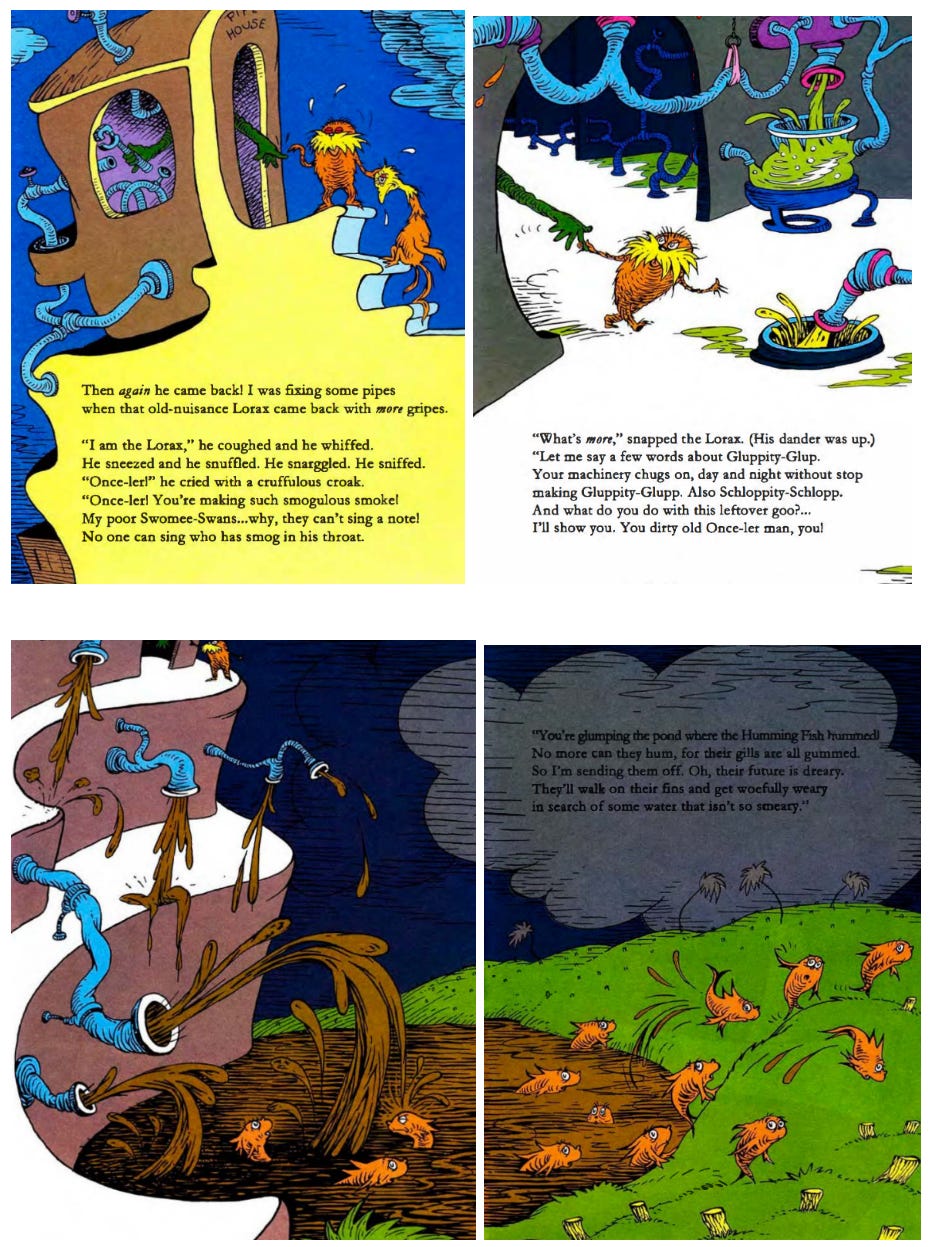
Oh, dear! When we fill our environment with smog and gunk, it becomes a hostile environment that cannot support the nice creatures who live there.
I see this same trend going on in social media. Feeds have become filled with smog and gunk. Some people leave, like the bar-ba-loots, swans, and fish. Others continue to ingest the content in front of them. The results are seen by the content they then contribute to the system.
In other words... junk in, junk out.
You are what you eat is a famous saying for a reason. We are now finding out that the content we consume affects our brains in a similar way to how the food we eat affects our bodies.
So what is our fate? Are we destined to have a digital landscape that looks as bleak as the landscape in The Lorax? Let’s check back for the final lesson.
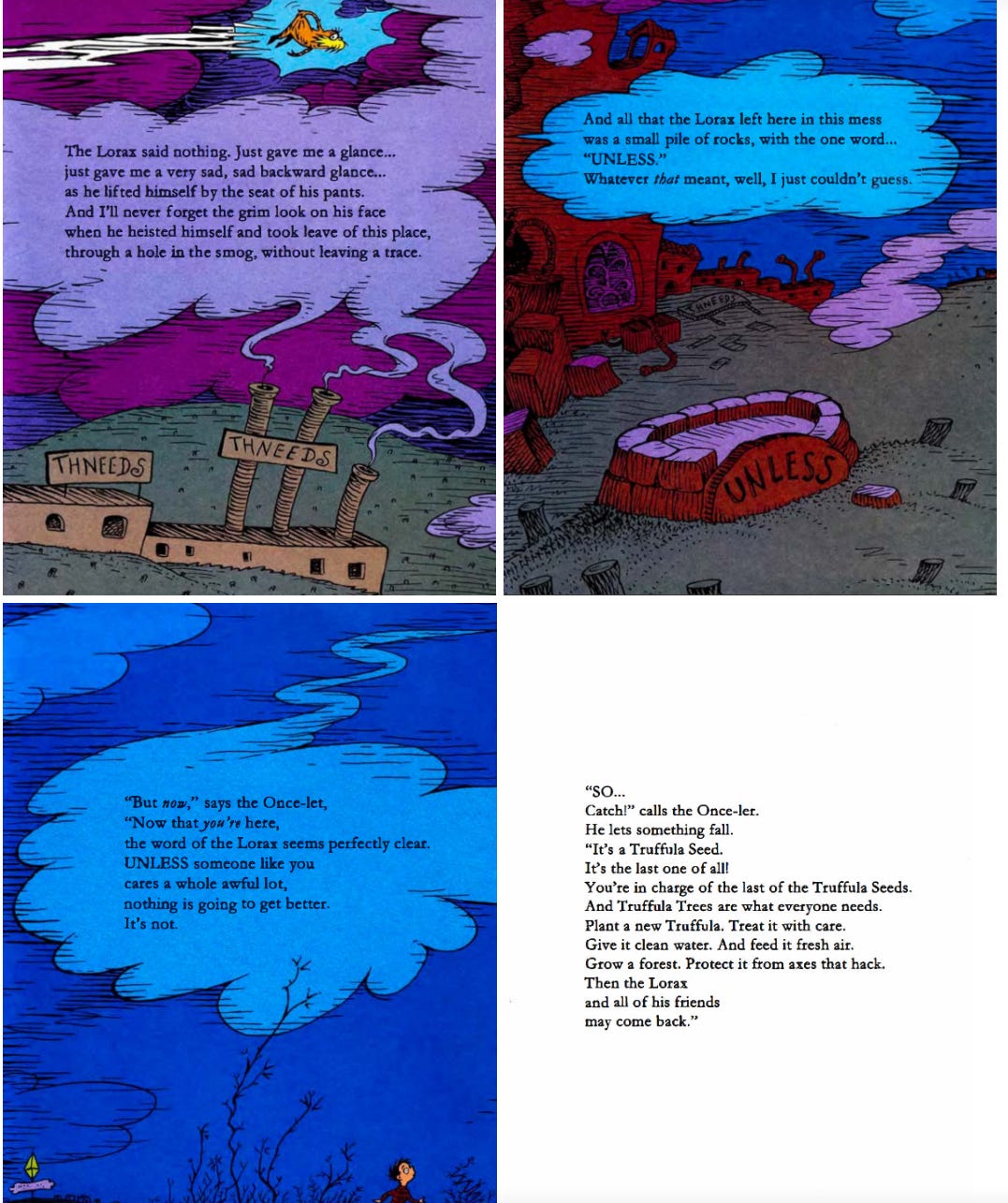
We appear to be at a fork in the road. We still have a (mostly) open and free internet that promotes sharing and connecting. This may not be the case forever, though, if we let current trends continue.
Are there enough people who care to make things better? Enough who are dedicated to nurturing their seeds and growing strong trees?
I’m optimistic. But if you asked me about a month and a half ago, I might have been less so. The reason is I’ve found my purpose. I have accepted the call to be someone who cares a whole awful lot.
We have to be careful though. If we set off on a crusade without thinking too critically, we may end up creating the environment we wish to avoid.
I used to think this was an issue with my generation. Millennials have taken a lot of grief from mainstream discourse, most of it has been unfounded. Yet the desire to complain instead of taking action seemed most prevalent with our generation.
However, the more I look, the more I see complaining happening everywhere. No real solutions. Just complaining.
This is that toxic smog and gunk that we must remove from our digital environment. Complaining is valid, but it only goes so far. As rule #19 from this post shows, people are great at pointing out problems, but not great at providing solutions.
It doesn’t matter if you don’t have the answers. You can still help clean up the environment. You can still choose to provide clean water and fresh air to the feed we all share.
Unless we move forward with strong values and principles, nothing is going to get better. It’s not.